
Anomalies in Plain Sight: What Three Military Incursions Tell Us About the UAP Risk Environment
4/22/2026
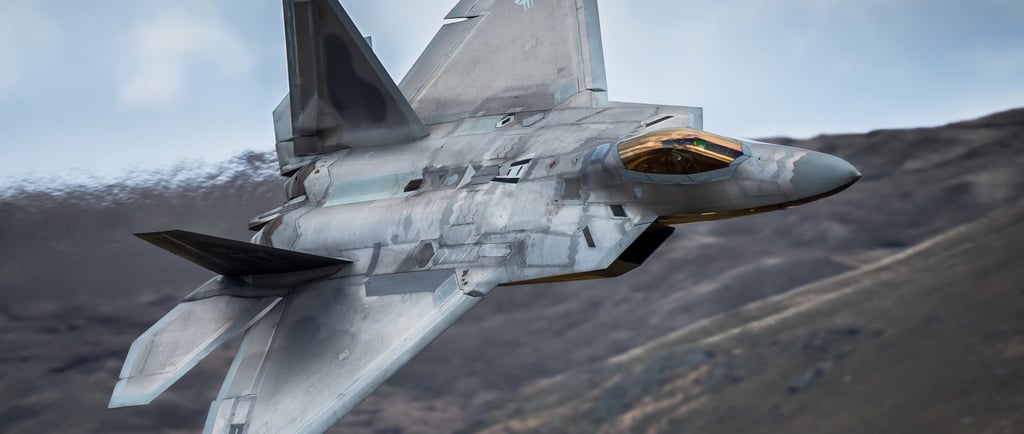
From Langley Air Force Base in 2023 to Fort McNair and Barksdale AFB in 2026, a pattern has emerged that official language has consistently failed to explain. The government calls them drones. Yet evidence suggests something more troubling, and far more interesting, than that label implies.
01 — Langley
In the winter of 2023, anomalous objects conducted sustained incursions over Langley Air Force Base in Virginia. The War Zone, which broke the story, described multiple weeks of incursions involving objects that defied easy identification. When NORAD Commander General Gregory Guillot was later pressed for specifics, he could offer only rough figures on number and altitude. One object, according to Air Force General Mark Kelly, was approximately 20 feet in length, flying in excess of 100 miles per hour at altitudes between 3,000 and 4,000 feet, operating in a manner inconsistent with commercially available consumer drone technology of the time.
The military's response was telling. Rather than scrambling fighters or engaging the objects, commanders watched. NORTHCOM, as Guillot acknowledged, had no clear authority to act. The objects entered and departed a highly sensitive military airspace without interdiction and without attribution.
"The incursions over Langley were among more than 600 reported over U.S. military installations since 2022." — NORAD Commander Gen. Gregory Guillot, October 2024
What made the Langley events significant was not just the penetration of restricted airspace, but the apparent operational sophistication: the objects demonstrated sustained loitering behavior, coordinated flight patterns, and the ability to evade or simply ignore interception procedures. None of this is consistent with a hobbyist mishap. Some of it is not consistent with known foreign drone programs of that era either.
02 — Fort McNair and Barksdale: The Pattern Accelerates
Three years later, the incidents have not only continued, but have escalated in strategic significance. In March 2026, unidentified aerial objects were detected over Fort Lesley J. McNair in Washington, D.C., where senior cabinet officials including the Secretary of State and Secretary of Defense reside. Military officials confirmed awareness of the sightings and stated there was "no credible threat," a phrase that by now carries its own weight of ambiguity. No origin was identified. No operator was apprehended.
Within days, Barksdale Air Force Base in Louisiana, a nuclear-capable installation home to B-52 bombers, experienced what Air Force Global Strike Command officially confirmed as "several unauthorized drone incursions that varied in duration and number of drones," beginning March 9, 2026. The incursions were significant enough that base leadership issued a temporary shelter-in-place order. A federal investigation was opened. Operational details were withheld citing security concerns.
Strategic Context: Barksdale AFB houses nuclear-capable aircraft and falls under Air Force Global Strike Command's purview over ICBM fields, weapons storage areas, and bomber operations. An unauthorized aerial incursion by "drones" over this installation is not a routine security matter, it is a strategic provocation and massive intelligence failure, regardless of the platform's origin or intent.
The objects at Barksdale reportedly displayed long-range control links and resistance to jamming, characteristics inconsistent with commercially available platforms. Their flight patterns suggested deliberate probing of detection timelines and response gaps rather than accidental intrusion.
03 — The Signature Similarities No One Wants to Admit
Lay the Langley, Fort McNair, and Barksdale incidents side by side, and a structural resemblance emerges that is difficult to dismiss.
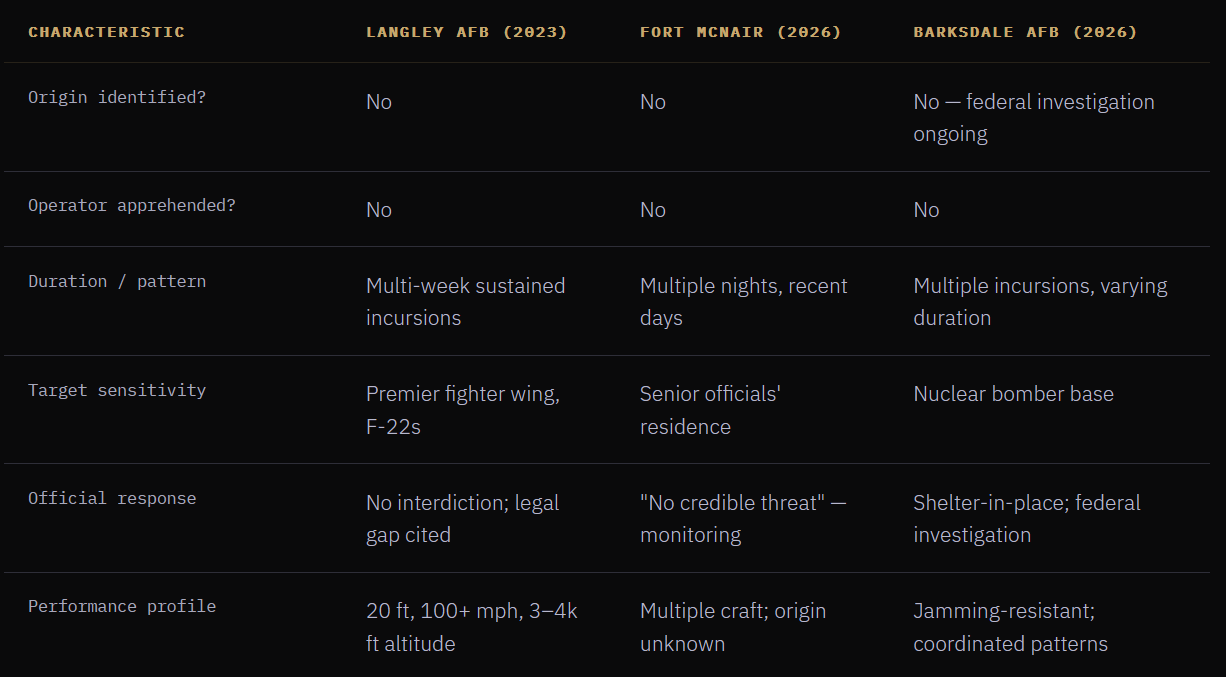
In each case, the government's default posture has been to label the objects as "drones" while simultaneously being unable to identify who built them, who flew them, or where they went. The word drone implies a known category of technology, a human operator, and a traceable chain of custody. None of those conditions has been met in any of these cases. Under the official U.S. government definition Unidentified Aerial Phenomena, or UAP, that is precisely what these objects are.
04 — Why "Drone" Is a Category Error
The instinct to classify these objects as drones is understandable. It is domesticating. It places them within a familiar regulatory and threat framework, one with known countermeasures, known legal authorities, and known adversaries. The problem is that the evidence does not consistently support that classification.
Consumer and commercial drones have finite range, visible radio frequency signatures, and relatively predictable flight envelopes. The objects over Langley were described as operating beyond those parameters. The objects over Barksdale reportedly demonstrated electronic resistance to jamming — a capability associated with military-grade or state-level systems. In multiple instances, objects have been observed without a traceable launch or recovery point, without associated RF emissions consistent with known platforms, and without any subsequent legal accountability.
The UAP framework — formally adopted by the U.S. government through the All-domain Anomaly Resolution Office (AARO) — exists precisely for this category of event: aerial phenomena observed near sensitive sites that cannot be attributed to known platforms or actors. General Guillot confirmed that he coordinates with AARO regularly. The same command structure that is tracking these "drones" is the one tasked with resolving UAP. That is not a coincidence. That is the government quietly admitting that the taxonomy has not caught up to the phenomenon.
05 — What This Means for Organizations
The policy and operational implications of this pattern are significant and underappreciated in mainstream risk analysis. If the objects are foreign state drones, the United States faces a persistent intelligence preparation of the battlefield problem on its own soil, with no established interdiction doctrine and demonstrated legal gaps in the authority to respond. If the objects are something other than conventional drones, the problem is more fundamental: the threat models that underpin physical security, airspace management, and critical infrastructure protection are built on assumptions about known aerial platforms that may not apply.
Either interpretation demands that organizations, particularly those operating near or within defense/space/energy/aeronautical adjacent sectors, reckon with a new operational reality. The aerial domain over the continental United States is no longer passive. The perimeter is no longer defined by the perimeter fence. And the language used by official sources to describe these events is not always a reliable guide to their nature.
At Inquire, we assist organizations in translating this evolving threat landscape into concrete, actionable frameworks before, during, and after the point of disclosure. Readiness is not a single moment; it is a continuous posture. The firms that build that capacity now will not be caught without a playbook when clarity is no longer optional, and they will not be starting from zero when the landscape shifts again.