
Several Alien Species and Several Dozen Bodies: Inside the June 9 Capitol Disclosure Event
6/9/2026
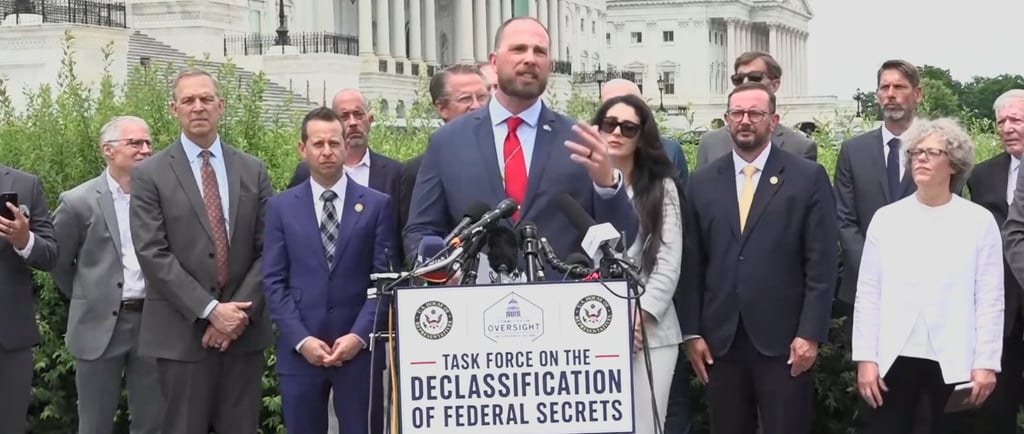
On June 9, 2026, a bipartisan group of lawmakers, former military personnel, whistleblower David Grusch, and investigative journalists Leslie Kean and James Fox gathered on the steps of the U.S. Capitol and pushed the disclosure conversation past hardware and into biology. The single most quoted moment of the event was Grusch's answer when a reporter asked how many non-human species the government is aware of. He declined to give a number, describing instead "a continuum from corporeal bipedal type life to sentient plasmoid life," and saying that we(United States)knows of 7.
For organizations tracking this issue as a risk vector rather than a curiosity, that sentence is the story. Not because it confirms a count, but because a credentialed former intelligence officer said it on the record, standing next to sitting members of Congress, and no one on that stage flinched.
What Was Actually Claimed
Grusch, the former National Geospatial-Intelligence Agency and National Reconnaissance Office officer who testified under oath in 2023, expanded his prior claims in two directions. First, the species continuum above. Second, he stated there have been several dozen cases involving what he calls non-human biologics, the term he uses for recovered biological material. He framed the entire matter as a national security and counterintelligence problem, noting that unowned objects have operated in restricted airspace over metropolitan areas and critical infrastructure, and that the agencies responsible for securing the homeland cannot reliably defend against them.
He also escalated the financial angle, alleging slush funds in the billions per year supporting these activities, and suggested the fraud task force led by Vice President Vance should investigate. That reframing is strategically deliberate. It moves the issue from a debate about belief to a debate about appropriations and oversight, which is far harder for agencies to wave away.
The Larger Architecture Around the Event
The species headline sat inside a coordinated political push. Rep. Anna Paulina Luna, who chairs the Task Force on the Declassification of Federal Secrets, and Reps. Eric Burlison, Tim Burchett, Jared Moskowitz, and Scott Perry used the event to call for permanent immunity for insiders, the waiving of nondisclosure agreements, and passage of the UAP Disclosure Act. Burlison named a roster of whistleblowers and called directly on the President to open the door. The group confirmed a forthcoming White House meeting on immunity.
The event also pulled international records into frame. Lawmakers referenced the 1996 Varginha, Brazil case and stated that former Brazilian Defense Minister Aldo Rebelo confirmed the incident, signaling that Brazil would reciprocate U.S. disclosure. Burlison described receiving MQ-9 footage of a UAP being fired upon off the coast of Yemen through what he likened to a dead drop. Leslie Kean used her remarks to argue that the conversation now needs to shift toward biology, away from technology, on the grounds that confirming another intelligent life form is a scientific question, not a national security secret.
Why This Fits the Disclosure Pattern We Have Been Tracking
This event did not happen in isolation. It lands directly on top of the PURSUE release cadence at WAR.GOV/UFO, which has already moved two tranches of declassified files into public view and absorbed well over a billion page views. The pattern is consistent: rolling document releases establish a public evidentiary baseline, and live events like June 9 supply the interpretive pressure, pushing for the conclusions the documents stop short of stating.
The center of gravity is moving from "are these objects real and unexplained" toward "what is operating them, and is it alive." That is a meaningful shift in the question, and organizations that calibrate their posture only to the hardware question are preparing for the wrong conversation.
What This Means for Risk Teams
For aerospace, defense, telecommunications, energy, and critical infrastructure operators, the actionable content here is not the count of species. It is the trajectory. A sustained, bipartisan, executive-aligned disclosure effort is now openly discussing recovered biological material, secret appropriations, and foreign government corroboration in the same breath. Whether or not every claim holds, the institutional momentum is real, and the reputational, regulatory, and operational environment around this topic is changing faster than most continuity plans assume.
The question for leadership is not whether to believe Grusch. It is whether your organization is positioned for a disclosure environment in which these claims are debated as policy rather than dismissed as fringe. That environment already exists.
Inquire will continue tracking the PURSUE releases, the Disclosure Act's progress, and the biology pivot, and publishing sector-specific analysis as the record develops. If your organization needs a structured read on what this means for your risk posture, contact us.